
AI is reshaping junior developer hiring, while automation proves critical for success
We’re excited to announce the release of our AI Pulse report: AI adoption and its impact on developer productivity. The report examines how developers and organizations are using AI today and the implications this has for the software development industry.
Based on primary survey data collected from technology professionals and leading third-party industry research, we found that widespread AI adoption was accompanied by varying levels of success. Differences in how developers with different levels of experience use these tools may have significant implications for talent development and organizational planning.
The productivity promise: real gains, real gaps
According to the 2024 State of Developer Ecosystem report, developers reported they were writing code faster (58%) and spending less time searching for information (67%). Organizations are investing up to 8% of revenue in AI tools for internal productivity.
Despite perceptions of productivity, McKinsey & Company reported that only 1% of leaders view their companies as “mature” on the deployment spectrum. This highlights a crucial gap between promise and reality.
This can occur when AI capabilities don’t align with the organization’s needs, particularly when infrastructure limitations absorb individual productivity gains. For example, AI may generate code faster while end-to-end delivery times remain the same.
How experience shapes AI use
AI adoption is universal: the 2025 Stack Overflow survey found that 47% of developers use AI tools daily in their development workflow, and another 32% use them infrequently.
Use of AI varies by developer experience level. Junior developers (0-2 years) demonstrated the highest use of AI across most tasks, including foundational tasks like learning new technologies, understanding codebases, and debugging code. Senior developers with 20+ years of experience who use AI are likely to stay current with emerging technologies.
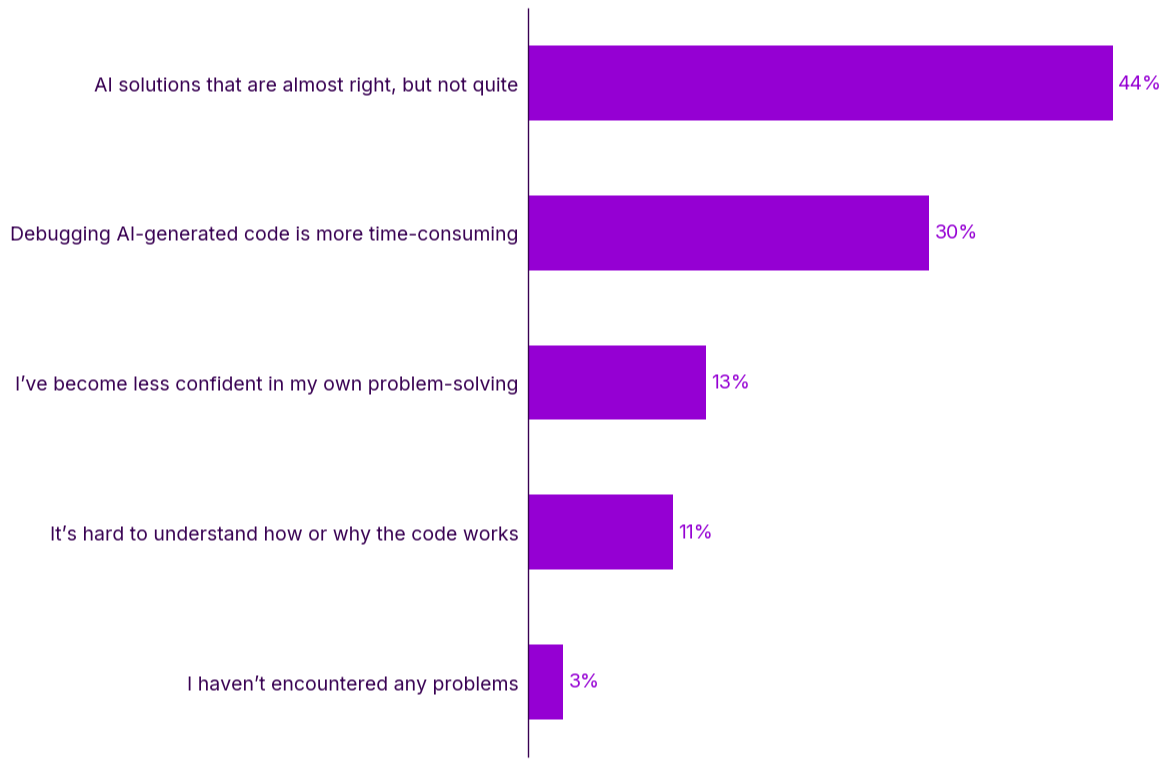
Perspectives on AI vary too: while the majority of developers have a favorable view of AI integration, 44% are frustrated with “AI solutions that are almost right, but not quite”, and 30% find debugging AI-generated code more time-consuming. Most concerning is that 13% feel less confident in their own problem-solving abilities.
The shifting junior developer landscape
AI excels at high-volume routine tasks, traditionally completed by juniors, like writing straightforward features, basic testing, and debugging simple issues. The 2024 Stack Overflow survey shows that junior developers spend approximately 85% of their time on routine tasks.
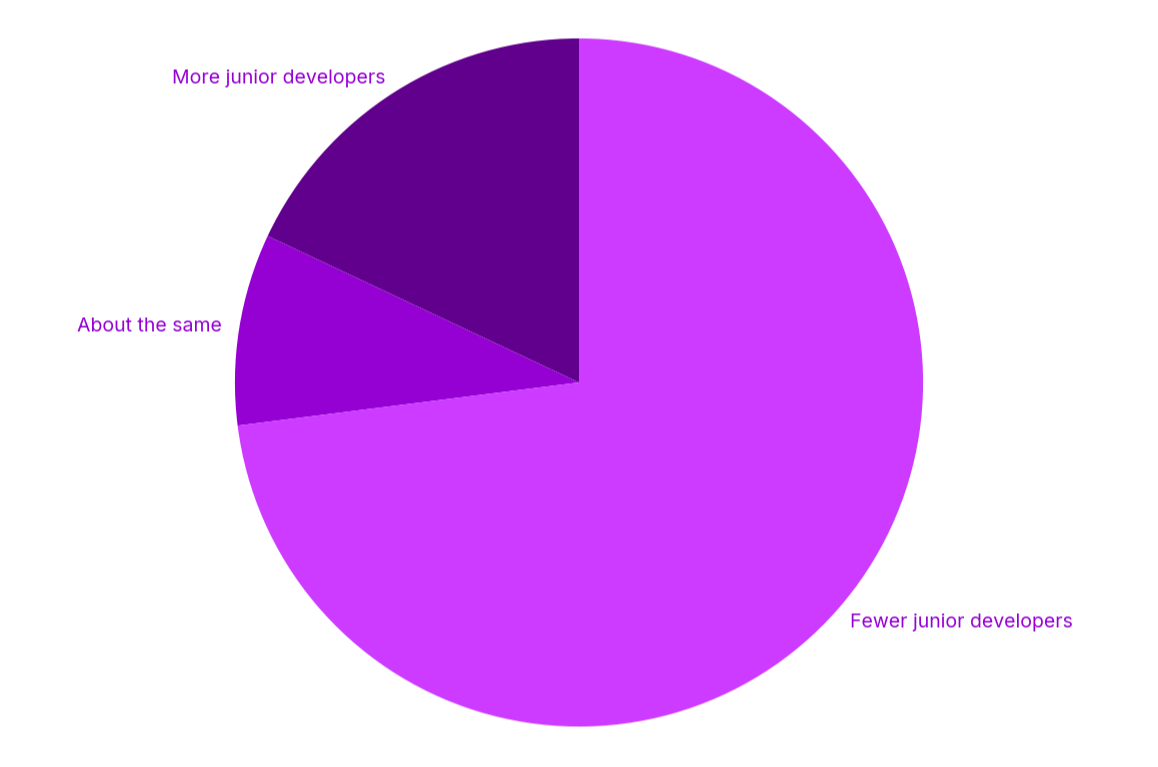
This is a compelling economic rationale for organizations reevaluating traditional hiring patterns, as evidenced by 73% of organizations reducing the number of junior developers they have hired over the past two years.
Junior developers see the most significant gains from AI assistance, completing tasks up to 55% faster. This reinforces a trend of AI-assisted developer productivity, where developers appear productive but may lack a deep understanding, increasing senior review workloads and creating skill gaps that may not scale with AI adoption.
Long-term talent implications
Hiring shifts, along with AI-mediated learning, could reshape the developer talent pipeline over the next 2-3 years. If organizations hire fewer junior developers, progression from junior to senior roles will face new challenges.
If traditional skill development (like debugging and error resolution) gets replaced or supplemented by AI, it may result in different types of knowledge depth. This transition in skill development affects many roles, with senior developers becoming more valuable as the expert talent pool shrinks.
A three-phase trend in the software delivery workforce
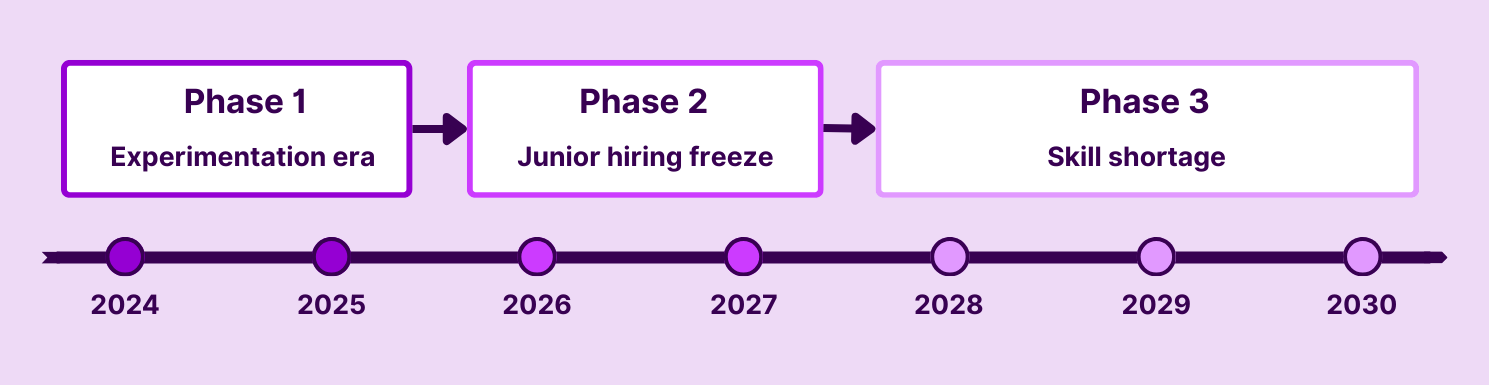
Our report introduces a three-phase prediction model:
- Phase 1 - Experimentation era: The current era, where organizations adopt AI broadly, focusing on optimizing its benefits for productivity, while uncovering underlying bottlenecks.
- Phase 2 - Hiring freeze: Organizations reevaluate the value of junior developers to advance their AI strategy and implement it further, while also retaining senior developers.
- Phase 3 - Skills shortage: Senior developer shortages due to reduced junior developer hiring, and AI-mediated learning, resulting in widening skills gaps and competition for experience.
Automation as the accelerator of AI value
Successful AI adoption requires more than just tool implementation. AI thrives on structure, with automation through Continuous Delivery practices emerging as key to scaling AI value. Organizations with established automated infrastructure before scaling AI adoption achieved substantially greater returns on investments.
The pattern is evident: AI scales the groundwork, and teams that successfully adopt AI typically have automated foundational practices in place, while those lacking them struggle to get value from their AI investments.
Planning for change
Adding AI tools to workflows addresses only a small part of the challenge, and without a clear intent, it can amplify existing problems. Organizations with mature deployment pipelines in place are able to successfully scale their AI investments; they see local gains translate into organizational outcomes.
Organizations that upskill junior developers alongside AI adoption are better prepared for long-term talent availability and development capacity.
AI is transforming software delivery, with success depending on the strategic integration of tools, the underlying deployment pipeline, and human development practices.
We encourage you to dive into the full report to explore the specifics of AI adoption, its capabilities, and the implications for hiring and talent development.
Happy deployments!