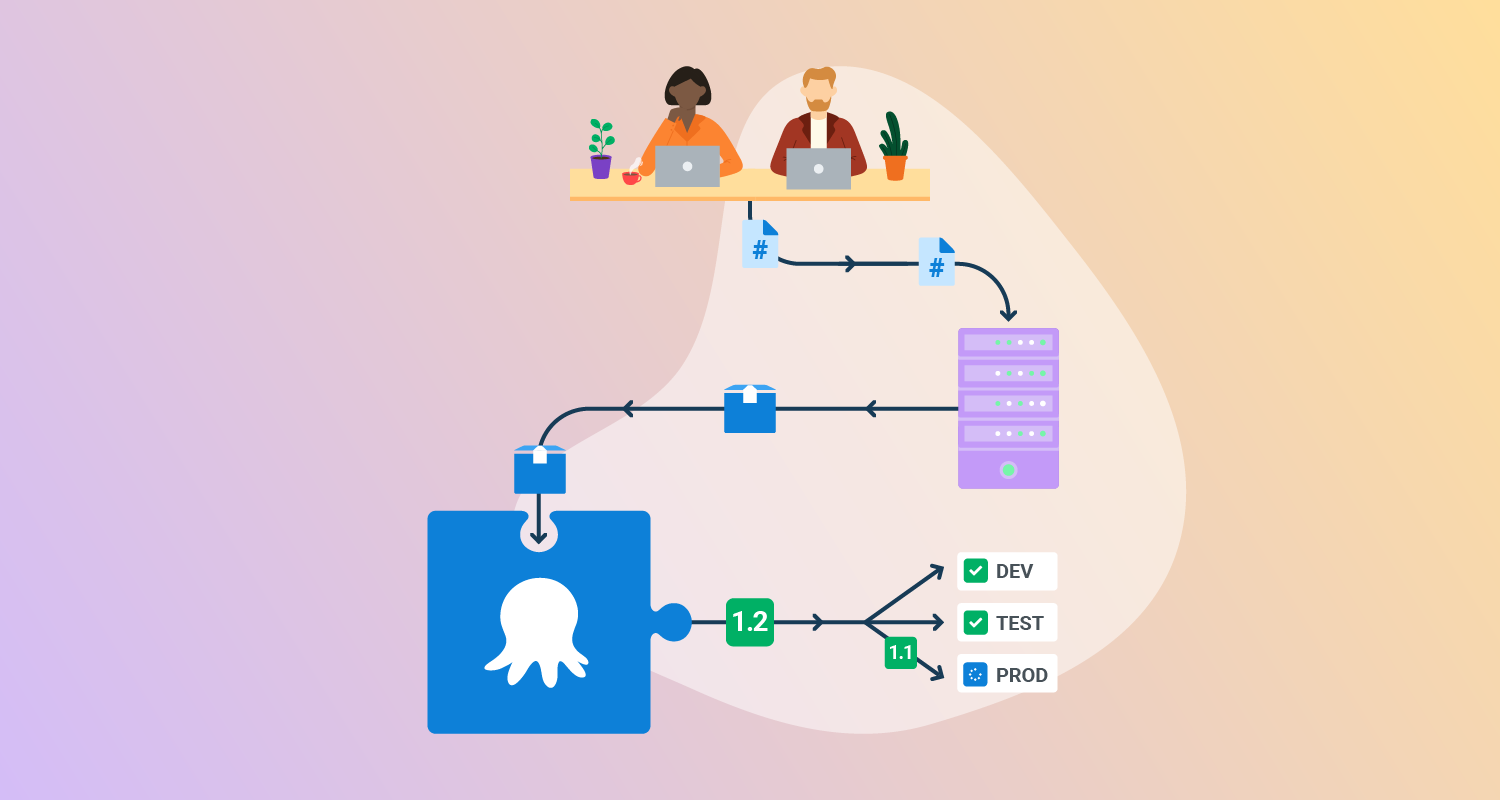
Though its principles and capabilities are Continuous Delivery’s most important elements, tools are still vital in its adoption. Tooling can help you manage, automate, and continually improve your most complex processes.
It’s best to approach tooling by focusing on the needs of each phase in your deployment pipeline. Each phase has its own priorities and purpose, and your choice of tools should support those.
Let’s look at some popular tooling options for each phase of a typical pipeline.
This is part of an extensive series of guides about Continuous Delivery.
Continuous Delivery market and trends
Market size and growth
The Continuous Delivery market is expanding rapidly as organizations invest in faster and more reliable software delivery. The global market is currently valued at USD 4.92 billion and is projected to grow to USD 20.17 billion by 2035, representing a compound annual growth rate of about 15%.
This growth reflects the increasing demand for modern software development practices that allow teams to release updates frequently while maintaining quality. As businesses rely more on digital platforms, Continuous Delivery has become a key part of maintaining fast development cycles and stable production environments.
Impact of AI on Continuous Delivery
Artificial intelligence is starting to play an important role in Continuous Delivery pipelines. AI tools help automate repetitive tasks and improve the accuracy of testing and monitoring processes.
For example, AI can assist with orchestrating test environments, executing deployment tasks, and monitoring the performance of release artifacts. These capabilities allow teams to identify issues earlier and maintain higher software quality.
AI also enables real-time insights during the deployment process. This helps teams detect errors faster, optimize release cycles, and improve decision-making during software delivery.
Vendors are already integrating AI into their platforms. In 2024, Harness announced updates to its software delivery platform that added AI-powered capabilities to help developers monitor and manage application updates more effectively.
Adoption by enterprise size and industry
Large enterprises currently represent the biggest share of the market, holding about 58% of revenue. Many large organizations operate in regulated sectors such as finance, healthcare, and government. These industries require strict controls and reliable release processes, which Continuous Delivery helps provide.
However, small and medium-sized enterprises (SMEs) are expected to increase their adoption significantly in the coming years. Continuous Delivery helps smaller teams improve productivity, reduce manual work, and release updates faster, allowing them to respond quickly to market changes.
Industry adoption also varies. The banking, financial services, and insurance (BFSI) sector account for the largest share of usage, at about 24% of the market. In these environments, Continuous Delivery helps automate testing, manage deployment stages, and reduce risk during software releases.
Meanwhile, the education sector is expected to see strong growth as online learning platforms and digital education tools expand.
Regional market trends
North America currently leads the global Continuous Delivery market, accounting for about 37.8% of revenue. The region benefits from strong technology adoption and the presence of major cloud and software companies such as Google, Microsoft, and Amazon.
Organizations in the United States and Canada are early adopters of cloud platforms and modern development practices, which supports the growth of Continuous Delivery tools and platforms.
The Asia-Pacific region is expected to experience some of the fastest growth, with projected growth of about 16.2% during the forecast period. Increasing digital transformation efforts and expanding technology sectors across the region are driving adoption.
Tools for Continuous Delivery
Planning
The planning stages are the most important for the direction and future of your product. Effective planning helps you focus on the improvements and features users get at the end of the next lifecycle.
Given a lot of that process can get pretty conceptual, there’s a range of tools that allow collaboration and project management.
Slack and Zoom are our main tools at Octopus, but other popular options include:
Code repositories and source control
Source control is important to every development team. Source control tracks and checks every new piece of code and file change.
Most developers use Git for source control. Git is both a system and philosophy, allowing for distributed development and helping avoid risk through branching.
Code repositories are hosting services for Git-managed code.
Popular options include:
Build and test
The most important tool for Continuous Integration, build servers (also known as CI platforms) can save time by automating:
- Code compiling
- Code validation tests
- Package creation
Popular options include:
Databases
There are many challenges with managing persistent storage. Applications are easy to deploy and roll back, but database changes are more complex. As well as managing schema changes and test data, database deployments could also conflict with application versions.
We wrote about database management in a series of articles on database deployment automation.
Many established patterns and tools can help you decouple your database deployments and data migrations.
Popular options include:
You can also use database-specific, integrated development environments against many database options, like JetBrains DataGrip or Visual Studio Code with database extensions.
Package
Packaging is another key part of Continuous Integration. Software packaging tools turn your code into deployable artifacts. You host and deploy these artifacts from package registries and repositories.
Popular options include:
Release and deployment
Release management and deployment tools help you get your software to environments where people can access it.
Though most code repositories and build servers let you manage releases and deploy to targets in some fashion, they don’t solve the same problems a dedicated deployment tool does.
Of course, Octopus is our deployment tool and we think it’s pretty great, but other popular options include:
Learn more in our detailed guide to Continuous Delivery vs Continuous Integration.

Steve Fenton is a Principal DevEx Researcher at Octopus Deploy and a 8-time Microsoft MVP with more than two decades of experience in software delivery.
Operations
Operations relates to the setup, running, and maintenance of infrastructure for all your processes.
Popular options include:
Octopus Runbooks can also help you with your operations tasks.
Monitoring
Monitoring tools scrape your product and related systems for important data. This can inform decisions about performance and customer usage.
Popular options include:
Learn more in our detailed guide to the benefits of Continuous Delivery.
Help us continuously improve
Please let us know if you have any feedback about this page.